The Gateway Advantage: Zero Obstacles to the Gulf
Redefining Deep-Water Access on the Mississippi River
Global maritime trade continues to evolve at an accelerated pace. Vessel sizes are increasing, environmental standards are tightening, and supply chains demand greater reliability. Ports that cannot adapt to these structural shifts face long-term constraints.
The Louisiana Gateway Port — as detailed in the Port Master Plan — is strategically positioned at the mouth of the Mississippi River with direct access to the Gulf of America (formerly Gulf of Mexico). Located below all major bridge crossings, the port offers unrestricted air draft, deep-water capability, and immediate Gulf connectivity.
This geographic positioning eliminates structural barriers and establishes Louisiana Gateway as a next-generation logistics platform serving global trade routes.
Accommodating the Era of Ultra-Large Vessels
The global order book currently reflects more than 11 million TEU of new capacity under construction — approximately one-third of the existing fleet being supplemented by larger, more efficient vessels.
Leading carriers such as MSC, Maersk, and CMA CGM continue to invest in Ultra-Large Container Vessels (ULCVs) exceeding 24,000 TEUs per voyage. These ships improve fuel efficiency per container and lower transportation costs, but they require ports capable of supporting greater draft and stacking heights.
Louisiana Gateway’s development anticipates this shift. Infrastructure alignment, berth configuration, and long-term throughput projections — outlined in the Economic Impact Analysis — reflect capacity planning designed to meet next-generation vessel requirements.
Eliminating Air Draft Constraints
Air draft — the clearance between the waterline and the highest point of a vessel — has become a limiting factor for many upriver ports. As container stacks increase, bridge crossings restrict access, requiring tidal coordination or load adjustments.
Louisiana Gateway’s location below all Mississippi River bridge crossings eliminates these operational constraints. The result is:
- Unrestricted stacking height
- No tidal scheduling requirements
- Reduced navigational complexity
- Enhanced schedule reliability
This structural advantage enhances predictability and reduces carrier exposure to delay-related costs.
Fifty Feet of Draft: Strength in Depth
Water depth directly impacts vessel profitability and cargo capacity. The Mississippi River Ship Channel’s progression to a 50-foot draft represents a significant milestone in strengthening Louisiana’s competitive position along the Gulf of America.
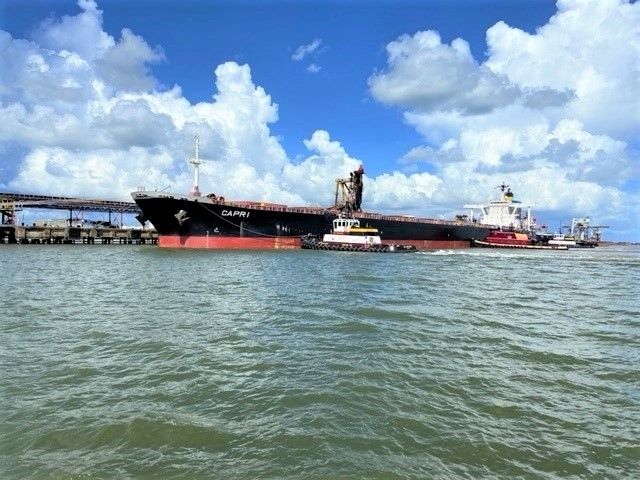
In August 2022, T. Parker Host facilitated the first vessel transit on the Mississippi River at a full 50-foot draft. The M/V Capri departed with approximately 134,000 metric tons of cargo, demonstrating the river’s enhanced deep-draft capability.
Source: https://www.tparkerhost.com/2022/08/10/host-sails-first-vessel-on-mississippi-river-with-50-feet-draft/
As the closest deep-water facility to the Gulf of America, Louisiana Gateway functions as a natural First Port of Call. This proximity reduces upriver transit time, lowers fuel consumption, and minimizes emissions — delivering both operational and environmental efficiencies.
Energy Infrastructure and Global Trade Alignment
The strength of the lower Mississippi River corridor is further reinforced by large-scale energy export infrastructure.
In 2024, Venture Global’s Plaquemines LNG facility received its first LNG carrier and initiated export operations. The LNG carrier Venture Bayou loaded its inaugural cargo bound for Germany, marking a significant expansion of U.S. LNG export capacity directly connected to the Gulf of America.
Source: https://maritime-executive.com/article/venture-global-received-first-vessel-at-new-plaquemines-lng-plant
These developments underscore the region’s ability to support high-value maritime commerce and global energy markets at scale.
Governance and long-term oversight supporting this growth are reflected in the Port’s leadership structure, detailed on the Commissioners and Staff page.
Multi-Modal Connectivity: From Gulf to Inland Markets
Louisiana Gateway’s advantage extends beyond marine access. The port integrates with:
- The 14,500-mile inland waterway system serving 31 states
- Six Class I railroads providing nationwide freight connectivity
- Major interstate corridors linking Gulf Coast industrial markets
This intermodal strength supports efficient cargo transfer from deep-water vessel to inland distribution networks.
As documented in the Economic Impact Analysis, the port’s continued development supports job creation, wage growth, and expanded participation for small and minority-owned businesses across the region.
Sustainability and Modern Infrastructure
Global trade increasingly prioritizes decarbonization and operational efficiency. By reducing upriver transit time and eliminating bridge-related delays, Louisiana Gateway directly reduces vessel dwell time and associated emissions.
Planned container terminal development — in partnership with APM Terminals — incorporates electrified crane capability, digital yard optimization, and advanced logistics systems designed to align with emerging environmental standards across the Gulf of America trade corridor.
Conclusion
Modern maritime trade requires infrastructure designed for scale, efficiency, and predictability.
Louisiana Gateway’s location below all bridge crossings, access to a 50-foot deep channel, and direct connectivity to the Gulf of America remove the structural barriers that limit many legacy ports.
The result is a clear, deep-water gateway connecting global shipping networks to the American interior — efficiently, reliably, and without obstruction.