Automated translation provided by Google. For official translations of vital documents, please contact info@gatewayport.com.
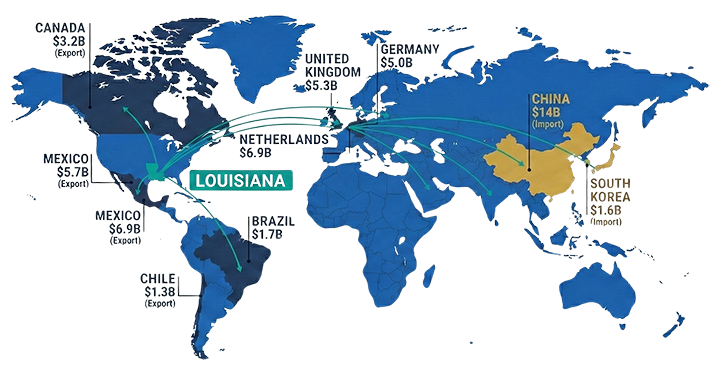
Louisiana Gateway Port’s proximity to open water at the mouth of the Mississippi River provides a measurable advantage for global trade. As the closest deep-draft port facilities to the Gulf of Mexico along the river, terminals within the Port’s jurisdiction offer reduced transit distance to Latin American ports and the Panama Canal—supporting shorter voyage times, improved vessel scheduling, and more efficient access to international trade lanes.
Trade moving through Louisiana Gateway Port reflects the scale and reach of the lower Mississippi River as a global commerce corridor. Through its jurisdiction, the Port supports significant international import and export activity connecting Louisiana and the central United States to markets across North America, Latin America, Europe, and beyond.
This global reach enables cargo owners, carriers, and industrial operators to participate in international trade while maintaining strong inland supply-chain connections.
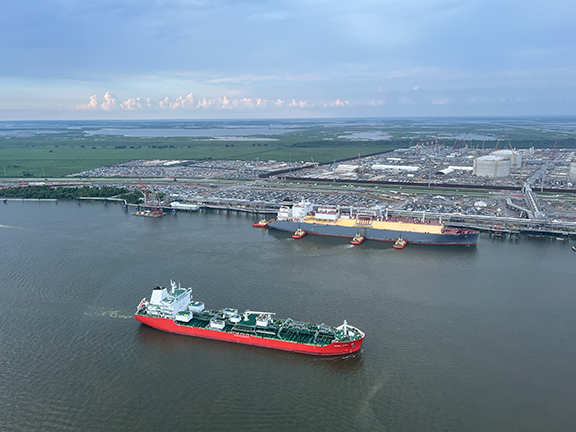
Louisiana Gateway Port jurisdiction spans the first 81 miles of the Mississippi River from the Gulf of Mexico inland, providing some of the most capable deep-draft access on the U.S. Gulf Coast.
These features support predictable vessel movement, reduced congestion, and operational reliability for ocean-going vessels serving global trade routes.
Louisiana Gateway Port supports a wide range of maritime trade by enabling access to infrastructure that accommodates diverse cargo types moving through the port district.
Cargo moving through the Louisiana Gateway Port territory includes:
Bulk and agricultural commodities
Breakbulk and project cargo
Containerized cargo
Energy-related cargo, including liquefied natural gas (LNG)
Other bulk materials supporting domestic and international trade
Cargo handling and terminal operations are performed by private operators within the port district.
Louisiana Gateway Port works collaboratively with cargo owners, vessel operators, terminal and logistics providers, industrial developers, site selectors, and public partners to support economic growth while maintaining transparency, safety, and long-term stewardship of port infrastructure.
As part of this collaborative approach, the Port supports strategic infrastructure initiatives, including the development of a modern container terminal within the port district. This planned investment reflects the Port’s role in coordinating long-term capacity expansion to meet evolving trade demands, while ensuring alignment with regional economic goals, environmental considerations, and community interests.
Cargo handling and terminal operations associated with these facilities are performed by private operators, consistent with the Port’s role as a public authority focused on access, infrastructure planning, and coordination.
This approach ensures Louisiana Gateway Port continues to serve both industry needs and the communities it supports—today and into the future.
New Sales at Businesses in the Region
$581.8M
New Earnings for Residents of Five Parishes
$180M
Average Jobs a Year
1,008 Jobs
New Taxes for Local Governments in the Region
$16M
Sales At Businesses in the Region
$90.2M
Household Earnings for Region Residents
$91.9M
Jobs for Citizens in the Region
933 Jobs
New Revenues for Local Governments in the Region
$6.7M
For questions about port access, connectivity, infrastructure, or doing business within the Louisiana Gateway Port district, contact us today.
Meet the commissioners and staff who help keep our port running smoothly.